August 17, 2026 – Co-Writing a Chapter
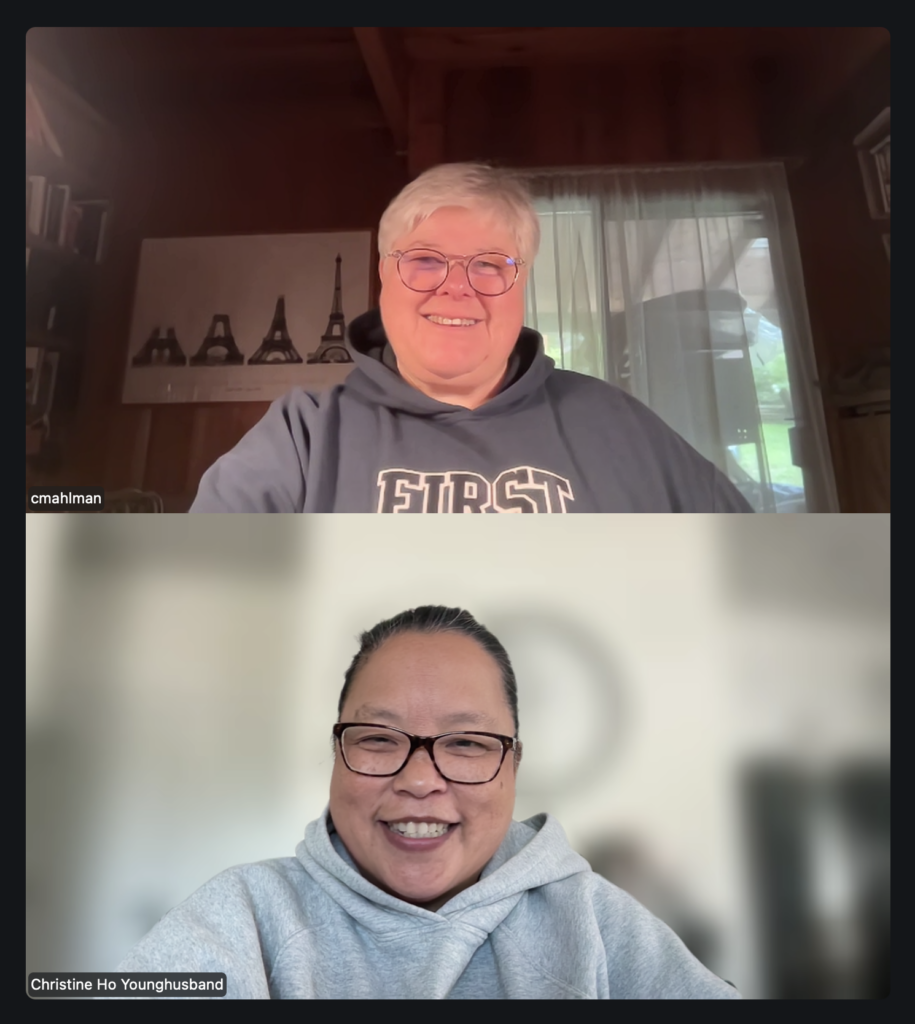
Yes… I do in-person selfies and Zoom selfies. It’s true!! I do love a good selfie. Here is an image of me and a colleague/friend from more than 20 years ago. We worked together on the Sunshine Coast. At the time, she was the District Aboriginal Education Principal and I was a secondary mathematics teacher. We both had a strong interest in professional development. When I was teaching in K-12 schools, I was often took the role of Professional Development School Representative. I loved working with my colleagues, co-creating with my colleagues, and learning something new about teaching and learning. As I look back, I can can really see that I appreciated professional learning and understand why teacher professional learning is part of my research program.
I am writing this blog post as I am reflecting on the conversations that I am having with my colleague/friend in recent weeks and months. We worked collaboratively together to work on a Math 8 project called, Math Embedded: A Tribute to Susan Point. I have written about this project in 2017, as seen inmy friend/colleague’s website titled “ImaginED.” This guest blog post was titled, “Integrating Indigenous Worldviews Into Secondary Math Teaching: A Tribute to Susan Point.” I also wrote about it for a piece for UNBC during Asian Heritage Month titled, “Learning to Embrace Identity” in 2023. I was also the key note speaker at the 3rd Annual Aboriginal Math K-12 Symposium at UBC in 2013. There were so many other opportunities that came about from the Math 8 project, such as “The Journey of a Lesson,” “Focusing on Competencies in Math” with Open School BC, FNESC Math First Peoples Teachers’ Resource Guide (2020), and curriculum development on BC’s Curriculum for Math K-9.
If anything, this Math 8 project took me on a pedagogical journey about teaching and learning, mathematics and culture, and creating something good for all learners, including myself. My colleague and I co-created and co-taught this Math unit on linear and rotational symmetry in 2009/2010, over 16-years ago, when the Math 8/9 Integrated Resource Package (IRP) was updated in 2008. In this provincial curriculum “Aboriginal Education” in math was introduced. At the time, there were so many things happening in the school: (1) 150-hours for Math 8; (2) got a new SmartBoard for my class from PAC; (3) delving into formative assessment practices; and (4) implementation of the new curriculum. I had no idea what I would do with all of the extra time in Math 8. Admittedly, I was a bit frustrated about the 150 hours for math (as the intervention to improve math achievement as students transitioned from elementary to secondary school).
Not be belabour my angst and anger, serendipitously connecting with my colleague shifted my mindset to a place of learning, excitement, and joy. I was very interested in learning about local Indigenous culture and ways of being, and what it meant to incorporate “Aboriginal Education” in to mathematics. Make note, 2009/2010 was well before the creation of the Truth and Reconciliation Calls to Action (2015) and formation/introduction of BC’s Curriculum (2016). Although the First Peoples Principles of Learning was developed In 2006/2007 with the BC Ministry of Education and FNESC as part of the English 12 First Peoples course (Chrona, 2014), this work was unknown to me as a high school math teacher. Yet, the work done on the Math Embedded project not only led me to professional learning opportunities as mentioned above, but also defined what kind of educator I wanted to be, and believe the educator I am today.
I had the the wonderful opportunity to contribute chapter to a book, alongside with contributors how are current math educators and educational leaders who seek to embedded Indigenous Education into Mathematics (or vice versa). I was honoured and excited to be invited, and I believe it’s the the learning that had come from the Math Embedded project, and it’s lingering effect on my practice, and maybe the impressions made on the editors of the book 13 years ago, that has led to another professional learning opportunity. In past, I would write about the Math Embedded Project from my vantage point, but with this invitation, I extended the invitation to my colleague to co-write this chapter with me. It was amazing to reconnect and we’ve been meeting weekly to share notes and research about the project, the work behind it, and the work that is ahead of it.
I write this blog post with awe and gratitude to look back at who I was as a practitioner, to unpack the math unit and why it mattered, and to figure out how we can once again co-create something like we did 16-years ago. I have been loving our conversations and feel that we are building the same momentum like we did many years ago. I’ve started reflecting on this work, and just listing out a few moments between Math Embedded and my practice today has taken some time to get some of my thoughts out. I am realizing that it will take some immense time to just get my memories and journey on paper, and the task of getting both of our stories woven together into 6000 words or less. It will be a task, but we have taken this road before, and we can do this together again.
Leave a Reply